There are many individuals who are responsible for the present day Huntsville Institutional Ministry. The list would include congregations, ministers, volunteers, chaplains, supporters, and friends of hard ministry work.
The organized church of Christ Prison Ministry (now Huntsville Institutional Ministry/ HIM) has been in existence for nearly sixty-four years and the story of its contributions in evangelizing men and women behind bars cannot be told, at least accurately.
This ministry is usually traced back to Clyde Thompson because it was about 1940 that P.D. Wilmit baptized Clyde Thompson into Christ. So a work was started even before Clyde was a part of it.
According to Ron Goodman, in 1964 an inmate in the Walls unit requested that someone come study with him. This one-on-one meeting developed into a small group that met once a month on Sundays.
Clyde Thompson, know as the Meanest Man in Texas, was released from prison on November 1,1955 after beginning his sentence in 1928. He did a variety of jobs then made his way back to Huntsville in 1970 to begin a “post release” ministry. Clyde describes what he did: “For some months we were able to personally go into three or four of the units and counsel with the men, but those opportunities have now been seriously limited. We meet the men coming out of prison; bring them here to the house; get them into some good clothes; keep them here for a time, in necessary, help them locate work; and talk with them about Christ.” Many came to Christ through Clyde’s efforts.
In 1970 Ron Goodman became the pulpit minister for the Huntsville church and began going into the prison to service the Christian inmates there. In 1972 he met with the Garland Street church of Christ in Plainview to talk about supporting his efforts. Since Garland Street had a thriving Bible correspondence ministry (National Bible Study) it was a natural fit. Thus began a relationship that has lasted for more than thirty years.
The early volunteers for the prison ministry include Jerry Harris, who continues to teach a class after thirty years, John Lassiter and Perry Barnes. Perry would later become a full time chaplain for the prison.
Luke Curtis is another name that is prominent with HIM. He, like Clyde, was an ex-convict. He met Clyde when he was released in 1975. He would become a significant part of the history. Clyde left the area in 1977 to move to Lubbock and Luke joined Ron in his work.
Ron and Luke’s work differed from Clyde’s in that they were allowed to go into the prison and conduct services, teach classes and counsel with the men. It started with that Sunday Wall’s class and blossomed into meetings on several units in the Huntsville area, correspondence courses and working with inmate families.
Ron left in 1981 to direct the Nashville churches efforts behind bars. The work fell into Luke’s capable hands and he expanded on the ministry even more than his predecessors.
Luke was an experienced substance abuse counselor so the ministry was able to offer help for the inmates in this area. He worked alone for many months after his partner Roger left the ministry. Classes were held on the Wynne, Walls, Ferguson and Eastham. The Walker county jail and Madison County jail would be added later.
In 1983 Freddie Anderson joined Luke in the ministry. The ministry experienced unprecedented growth in terms of numbers of baptisms, enrollment in correspondence course, college credit courses through Sunset School of Preaching and inmates being placed in congregations. A class for the females in Walker county jail was added, class at Goree, Estelle, and Madison County Jail.
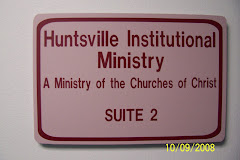
Luke passed December of 1990 and Freddie Anderson became the director. Pinky Bates came to work in the ministry for several years; Ray Clyde joined the team after him and Frank Turner was added as a third man. Today the ministry has unparallel success among the incarcerated. About three years ago from the ministry became known as “Huntsville Institutional Ministry” because the work went beyond just prisons: we go into a variety of institutions, perform a variety of services, ministers in various states across the country, and the instructions include Bible teaching, worship services, addictive behavior classes, post release placement, job help, various assistance, workshops, and training of other prison workers.
We minister to almost a thousand inmates a month; have averaged almost seventy baptisms over the years; distribute dozens of Bibles; and the list goes on. Many who preach were once incarcerated.
Without the faithful commitment of the congregations, and individuals this work would not be possible. Texas has more than 162,000 inmates with the greatest concentration of inmates being in the Huntsville area. Our mission statement, “to make the gospel available to all men, regardless of their past lives,” reflects our intentions to minister to the “whole” man.



No comments:
Post a Comment